



How to Translate Bisaya to English Accurately: A Complete, Modern Guide
Learning to translate Bisaya to English can be challenging for many language learners and travelers alike. Bisaya, also known as Cebuano, is widely spoken across the Visayas and Mindanao regions of the Philippines. Its unique sentence structures and cultural expressions often make direct translations into English difficult. This guide is crafted to provide a clear and practical understanding of Bisaya words, phrases, and grammar, enabling learners to communicate effectively in English while preserving the nuances of the original language.
Translating Bisaya to English is not just about converting words; it involves understanding context, sentence structure, and idiomatic expressions. Unlike English, Bisaya often relies on actor-focus and object-focus verbs, which can change the meaning based on sentence placement. This article explains these differences with practical examples, ensuring learners can navigate real-life conversations, written texts, and cultural expressions without confusion.
The purpose of this guide is to provide an easy-to-follow approach for translating Bisaya to English, whether for personal learning, professional communication, or travel. By the end, readers will be equipped with essential vocabulary, phrases, grammar tips, and translation tools to confidently interpret Bisaya into fluent English. This structured approach ensures clarity, accuracy, and natural expression, avoiding literal mistakes while respecting cultural meaning. This article reflects current language-technology trends, modern translation practices, and real user search intent, making it useful for learners.
What Is the Bisaya Language?
Bisaya refers to a group of languages spoken throughout the Visayas and large parts of Mindanao in the Philippines. Linguistically, Bisaya languages belong to the Austronesian language family, one of the largest language families in the world.
The most widely spoken and internationally recognized Bisayan language is Cebuano, which is why most Bisaya to English translation tools actually translate Cebuano.
Key Linguistic Features of Bisaya
Verb-focus grammar instead of subject-first structure
Heavy use of affixes to mark tense, aspect, and focus
Flexible word order driven by emphasis
Frequent use of particles that modify meaning
Strong influence from Spanish and English loanwords
Understanding these characteristics is essential for producing accurate English translations that sound natural rather than mechanical.
Is Bisaya the Same as Cebuano?
This is one of the most common search queries related to Bisaya language translation.
Clear Distinction
Bisaya → A broad category covering multiple Visayan languages
Cebuano → One specific Bisayan language, spoken by over 20 million people
Other Bisayan languages include Hiligaynon, Waray-Waray, and Kinaray-a, which are not mutually intelligible with Cebuano in many cases.
Why This Matters for Translation
When translating Bisaya to English, identifying whether the source text is Cebuano is critical because:
Vocabulary differs across regions
Idiomatic expressions change meaning
Grammar patterns may vary
Most online translators default to Cebuano, which explains inconsistencies when translating regional Bisaya content.
How Does Bisaya to English Translation Actually Work?
Unlike English, which relies on a subject-verb-object (SVO) structure, Bisaya relies on verb focus. This means the verb determines which part of the sentence is emphasized.
Example Breakdown
Bisaya:
Gihatag sa babaye ang libro sa bata.
Literal Word Order:
Given by the woman the book to the child
Correct English Translation:
The woman gave the book to the child.
Achieving this translation requires:
Identifying the completed-action verb (gi-hatag)
Recognizing focus markers (sa, ang)
Reconstructing the sentence into natural English syntax
This is why direct, literal translation fails for Bisaya.
How Regional Variation Within Bisaya Affects English Translation Accuracy
One of the most overlooked but critically important factors in Bisaya to English translation is regional variation. While many people treat Bisaya as a single, uniform language, it actually varies significantly across different parts of the Philippines. These variations directly affect word meaning, sentence intent, and translation accuracy, especially when translating into English.
Ignoring regional differences is a major reason why translations that seem “correct” still sound off, misleading, or incomplete.
Bisaya Is Not Linguistically Uniform
Bisaya is an umbrella term that includes multiple regional speech varieties, with Cebuano being the most dominant. However, Cebuano itself differs depending on location. The most influential regions include:
Cebu (Metro Cebu and nearby provinces)
Bohol
Negros Oriental
Northern and Southern Mindanao
Each region introduces differences in:
Vocabulary choice
Verb usage and preference
Idiomatic expressions
Tone and emphasis
These differences may seem subtle to native speakers but can significantly alter meaning when translated into English.
Vocabulary That Changes Meaning by Region
Some Bisaya words exist across regions but carry different meanings or usage intensity, which can lead to incorrect English translations if regional context is ignored.
Example: “libog”
In Cebu: confused, disoriented
In some Mindanao areas: can imply moral confusion or poor judgment
English translations like “confused” may be accurate in one region but incomplete or misleading in another.
Example: “hilig”
Cebu: preference or interest
Bohol: stronger inclination, sometimes habitual
Correct English rendering depends on regional intent, not dictionary definition.
Regional Preferences in Verb Usage
Different regions often favor different verb constructions, even when expressing the same idea.
Cebuano speakers in urban areas may prefer shortened, conversational forms
Rural or provincial speakers may use more explicit verb constructions
Mindanao Cebuano often retains older or more formal verb usage
For translators, this affects:
Verb tense interpretation
Whether English should sound casual or formal
How certainty or intent is expressed
A translation that ignores these differences may sound unnatural or misrepresent the speaker’s tone.

Idioms and Expressions Are Region-Specific

Idioms and Expressions Are Region-Specific
Many Bisaya idioms are not universally understood across regions, even if the words themselves are familiar.
An expression commonly used in Cebu may:
Sound unusual in Bohol
Carry stronger emotional weight in Mindanao
Be rarely used elsewhere
When translating such expressions into English, the translator must decide whether to:
Preserve the implied meaning
Replace it with a neutral English equivalent
Rephrase entirely for clarity
This decision cannot be made accurately without regional awareness.
Why Most Translation Tools Struggle With Regional Bisaya
Most online translators and AI tools treat Bisaya as standard Cebuano, usually modeled after Metro Cebu usage. As a result:
Regional vocabulary may be mistranslated
Idioms may be translated literally
Tone and emphasis may be flattened
This is not a flaw in technology alone—it reflects the lack of labeled regional data available for Bisaya variants. Human judgment remains essential when regional nuance matters.
Practical Strategies for Handling Regional Variation
To improve Bisaya to English translation accuracy, apply these strategies:
Identify the speaker’s region whenever possible
Watch for vocabulary that has multiple interpretations
Avoid overly specific English words when meaning is ambiguous
Prioritize intent and tone over literal wording
Cross-check unfamiliar terms with regional sources
When unsure, neutral English phrasing is often safer than an overly precise but incorrect translation.
Common Bisaya Words and Their English Meanings
Building a strong vocabulary base improves both comprehension and translation speed.
Frequently Used Bisaya Vocabulary
| Bisaya Word | English Meaning |
|---|---|
| Salamat | Thank you |
| Palihug | Please |
| Maayo | Good / Fine |
| Dili | No / Not |
| Gutom ko | I am hungry |
| Kapoy | Tired |
| Gugma | Love |
These words appear frequently in spoken Bisaya, written Cebuano, and everyday conversations, making them essential for translation accuracy.
Everyday Bisaya Phrases Translated into Natural English
Understanding phrases—not just words—is critical for context-aware translation.
High-Frequency Bisaya Phrases
Unsa imong ngalan? → What is your name?
Asa ka padulong? → Where are you going?
Maayong buntag! → Good morning!
Ayaw kabalaka → Don’t worry
Pwede ba? → Is it allowed? / Can I?
These phrases often appear in search queries, travel scenarios, and language-learning contexts, making them ideal for featured-snippet targeting.
How Bisaya Grammar Works (Explained for English Speakers)
1. Verb Affixes in Bisaya
Bisaya verbs encode tense and focus through prefixes, not auxiliary verbs.
| Affix | Function |
|---|---|
| mag- / mo- | Future or intent |
| nag- | Past or ongoing |
| gi- | Completed action |
Example
Nagkaon ko → I am eating / I ate
Mokaon ko → I will eat
English requires restructuring, not substitution.
Actor-Focus vs Object-Focus: Why It Matters
This is one of the most misunderstood aspects of Cebuano to English translation.
Actor-focus emphasizes the doer
Object-focus emphasizes what is acted upon
English usually neutralizes this distinction, which is why translators must decide what matters most in context.
Sentence Structure Differences Between Bisaya and English
| Feature | Bisaya | English |
|---|---|---|
| Word order | Flexible | Fixed |
| Subject | Often implied | Required |
| Tense | Embedded | Auxiliary verbs |
| Emphasis | Verb-based | Subject-based |
Accurate Bisaya to English translation requires restructuring sentences for clarity, not mirroring form.
Best Tools for Translating Bisaya to English in 2026
1. Google Translate
Fast and accessible
Useful for single sentences
Weak with idioms and nuance
2. AI Translation Models
Better semantic understanding
Handles longer content
Still benefits from human review
3. Cebuano Dictionaries
High lexical accuracy
Limited conversational examples
4. Language Learning Apps
Improve vocabulary retention
Support pronunciation practice
Using multiple tools together produces better results than relying on one source.
Human vs AI Translation: What Produces Better Results?
AI Translation Strengths
Speed
Scalability
Cost efficiency
Human Translation Strengths
Cultural interpretation
Emotional tone
Idiomatic accuracy
For professional or public-facing content, a hybrid approach delivers the highest quality.
Common Mistakes in Bisaya to English Translation
Literal translation of idioms
Ignoring verb focus
Misreading particles like ba, na, pa
Assuming one-to-one word equivalence
Avoiding these errors significantly improves translation quality.
Is Bisaya Hard to Translate into English?
Bisaya is moderately challenging, mainly due to:
Verb affix systems
Context-dependent meaning
Regional variation
However, its grammar is highly systematic, making mastery achievable with structured practice.
 Why Learning Bisaya to English Translation Is Valuable
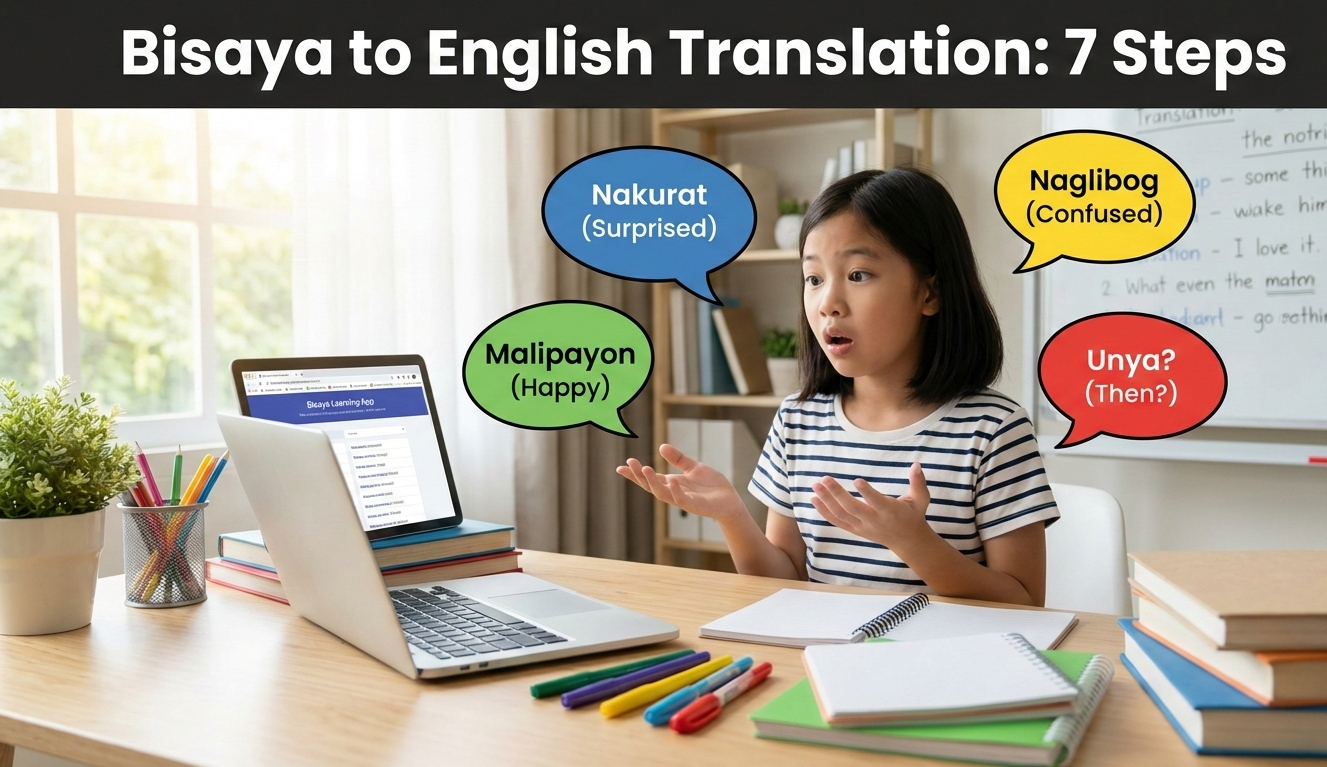 Why Learning Bisaya to English Translation Is Valuable
Easier communication in the Philippines
Improved career opportunities in localization and BPO
Deeper cultural understanding
Strong foundation for other Philippine languages
Multilingual skills remain a high-value global asset.
How Translation Quality Impacts Real Outcomes: Travel, Work, Education, and Digital Content
Translation accuracy is not an academic concern—it has real-world consequences. In everyday situations, even small translation errors can change outcomes, damage relationships, or cause confusion. Understanding where Bisaya to English translation quality matters most helps readers prioritize accuracy over speed.
Travel and Daily Communication
For travelers or newcomers to Bisaya-speaking regions, translation quality affects:
Directions and transportation
Food orders and accommodations
Social interactions and politeness
A poorly translated sentence may sound rude, abrupt, or confusing, even if the vocabulary is correct. Politeness markers and indirect phrasing are especially important in Filipino culture, and English must reflect that tone appropriately.
Workplace and Professional Settings
In professional contexts, translation errors carry higher risk. Common problem areas include:
Instructions and procedures
Requests and responsibilities
Agreements and commitments
For example, a Bisaya sentence that implies suggestion may be translated as a command if nuance is lost. This can lead to misunderstandings, strained relationships, or perceived disrespect.
In sectors like:
Customer service
BPO and outsourcing
Localization and content moderation
accurate Cebuano to English translation directly impacts performance and credibility.
Education and Academic Use
Students translating Bisaya into English for:
Essays
Research summaries
Oral presentations
often struggle with over-literal translations. Academic English requires:
Explicit logical connections
Clear subject reference
Formal tone
Meaning-based translation ensures that ideas are not just understandable, but academically acceptable.
Digital Content, Media, and Online Publishing
For blogs, subtitles, social media, and videos, translation quality affects:
Audience trust
Engagement rates
Brand perception
Literal translations often sound robotic and reduce emotional impact. In contrast, well-adapted translations preserve humor, emphasis, and intent—making content feel native rather than translated.
This is especially important as AI-generated content becomes more common and audiences become more sensitive to unnatural language.
Long-Term Impact: Trust, Clarity, and Cultural Respect
High-quality translation does more than convey information—it builds:
Trust between speakers
Cultural understanding
Clear expectations
Poor translation does the opposite, even when intentions are good.
For learners, professionals, and content creators, investing in accurate Bisaya to English translation is not optional—it is foundational to effective communication.
Key Takeaway
Strong translation:
Preserves intent
Reflects context
Respects cultural nuance
Weak translation may be readable, but it fails where it matters most—in real outcomes.
How Verb Focus, Affixes, and Particles Change Meaning Across Different Communication Contexts
Why the Same Bisaya Sentence Translates Differently Depending on Context
In real-world Bisaya usage, verb focus, affixes, and particles do not operate in isolation or in textbook conditions. Their meaning shifts depending on whether the sentence is spoken casually, used in storytelling, written formally, or delivered in emotionally charged situations.
This is where many translations fail—not because the grammar is wrong, but because context is ignored.
For example, the same verb form can indicate:
A neutral statement in casual speech
A defensive justification in conversation
A completed obligation in formal writing
English requires different constructions for each scenario.
Contextual Translation in Spoken vs Written Bisaya
Spoken Bisaya frequently omits elements that are assumed through shared understanding. Written Bisaya, especially in formal or instructional contexts, tends to make relationships explicit.
Spoken:
Gihatag na.
Possible meanings in English:
“It’s already given.”
“I already gave it.”
“That has been taken care of.”
Written or formal:
Gihatag na sa opisina ang dokumento.
Clear translation:
“The document has already been submitted to the office.”
Here, particles carry more weight in spoken language, while noun markers and structure clarify meaning in written form.
How Emotional Tone Alters Translation Choices
Particles such as gyud, lagi, and man frequently signal emotion or stance, not new information. English must translate the effect, not the particle.
Gihatag na gyud nako.
Depending on tone, this may translate as:
“I already gave it, seriously.”
“I’ve definitely already handed it over.”
“I told you, I already gave it.”
A literal translation misses the emphasis and frustration conveyed by gyud.
Politeness, Authority, and Social Distance in Verb Usage
Bisaya uses subtle grammatical choices to express respect, authority, or familiarity. This often affects translation in professional or hierarchical settings.
Mahimo ba nimo ihatag ang papeles?
This is grammatically a question, but functionally a polite request, not a literal inquiry.
Correct translation:
“Could you please hand over the documents?”
Not:
“Is it possible for you to give the papers?”
Understanding speech intent prevents awkward or overly literal English.
Frequently Asked Questions
What does Bisaya mean in English?
It refers to Visayan languages spoken in central and southern Philippines.
Is Cebuano harder than Tagalog?
Not harder—just structured differently.
Can Google Translate accurately translate Bisaya?
It works for basics but struggles with nuance and idioms.
What’s the fastest way to learn Bisaya translation?
High-frequency vocabulary, grammar patterns, and real usage.
Final Thoughts
Accurate Bisaya to English translation depends on understanding grammar focus, context, and cultural meaning—not literal substitution. By combining linguistic knowledge with modern translation tools, learners can achieve clarity, fluency, and confidence.